
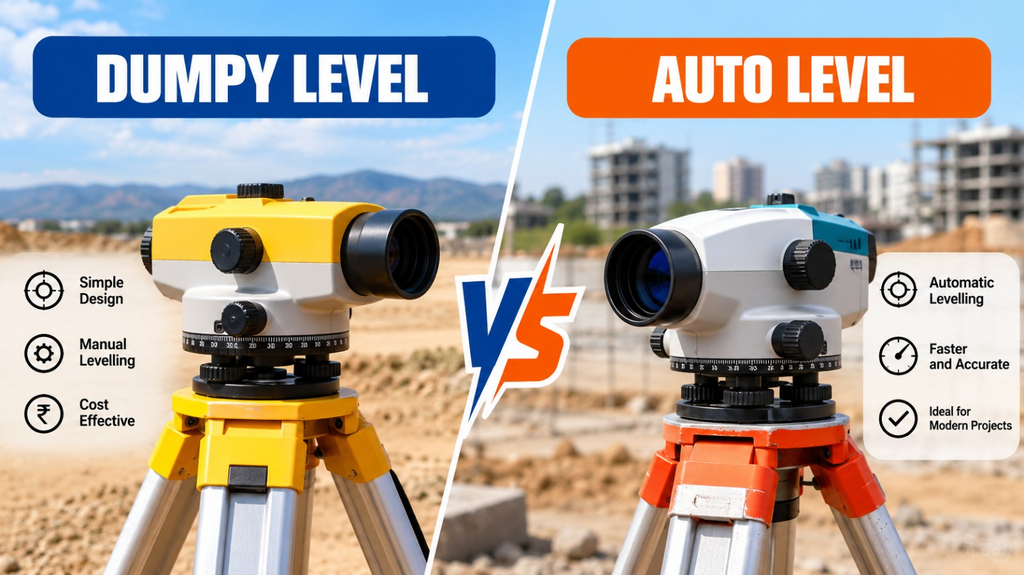
If you have worked on a levelling job, you have probably wondered which instrument to take: the dumpy level or the auto level. Both do the same basic work. You set one up, look through the telescope at a staff, and find out how much higher or lower one point is than another. But the two behave differently once you are on site. One takes longer to set up, one copes better with a passing truck, and one shows you when something is wrong while the other may not.
This post looks at what changes in the field, not at the specification sheet. If you want the basics first, read our dumpy level guide. If you already know them, start with the biggest difference: who keeps the telescope level.
Hands On or Hands Off: Who Really Does the Levelling?
Before you read the staff, the telescope must look perfectly flat. If it tilts even slightly, every reading is wrong. Both instruments need this. The difference is who makes it flat.
- Dumpy level: You do. You turn the foot screws until the bubble sits in the middle, and then you keep checking it.
- Auto level: The instrument does. Inside is a small hanging part called the compensator. It swings and keeps the view flat on its own.
- With an auto level, you only bring a small round bubble close to the centre. It does not need to be exact.
- The compensator can correct only a small tilt, often no more than about a quarter of a degree. Your instrument’s datasheet gives the exact figure.
- If the tilt is bigger than that, the compensator cannot correct it, and the reading will be wrong.
Setup Time: Dumpy Level vs Auto Level
This leads straight to the next difference. Making the telescope flat takes more time on one instrument than on the other.
- A dumpy level takes longer. You centre the bubble, turn the telescope, and check the bubble again.
- An auto level is quicker. Rough levelling is enough, and you can start reading.
- Here is a simple example. These times are only to show the idea. Say a dumpy setup takes 3 minutes and an auto setup takes 1 minute.
- If you move the instrument 30 times in a day, you save 2 minutes each time. In total, that is about one hour.
- On a long run with many moves, that hour matters. If you read many points from one spot, the difference is small.
Wind and Vibration: Which Level Settles Faster?
Once you are set up, the site starts to interfere. Trucks pass, machines run and the wind blows.
- On a dumpy level, wind or a passing truck makes the bubble shake. You wait until it stops.
- On an auto level, the compensator has a damper. This calms it quickly, so it settles faster after a truck passes.
- Steady vibration, like a compactor working next to you, is a problem for both. Move to another spot, or wait until the machine stops.
How Each One Handles UAE Summer Heat
Summer adds another problem. In the UAE, heat affects the instrument and the air your line of sight passes through.
- On a dumpy level, sun on one side can slowly move the bubble. Check the bubble again between readings.
- An auto level has no long bubble that can move. But every instrument has a temperature limit. You can find it in the datasheet.
- Use an umbrella to shade either instrument.
- Keep your line of sight well above the hot ground. Over hot sand or fresh asphalt, the air shimmers, and the staff looks like it is moving. This spoils readings on both instruments.
What If the Level Gets Dropped or Knocked?
Sooner or later, something gets knocked on every site. Both instruments can be damaged, but you find the damage in different ways.
- A dumpy level is solid. If a knock moves something, you can usually see it. The bubble goes off centre, or the readings do not match.
- An auto level has a delicate moving part inside. A hard knock can make the compensator stick. The instrument still gives you a clear reading, so you may not notice anything is wrong.
- After any drop, or a long drive over a rough road, get an auto level checked before you use it.
- For a dumpy level, check the bubble and do a two-peg test. In this test, you read two pegs from the middle, then read them again from one end. If the height difference is not the same both times, the instrument needs adjusting.
Dumpy Level vs Auto Level at a Glance
| What changes | Dumpy level | Auto level |
| Who levels the line of sight | The operator, with a bubble | The compensator |
| Setup speed | Slower | Faster |
| Wind and traffic | Bubble may shake | Usually settles quickly |
| After a knock | Damage is easy to see | Compensator may stick without warning |
| Field repair | Bubble and crosshair screws | Compensator needs a workshop |
Conclusion: Match the Level to the Job
Neither instrument wins every time. An auto level is quicker to set up, which helps on a busy site where you move often, while a dumpy level is simpler and easy to correct in the field. Choose by the job: how often you’ll move, how rough the ground is, and how your crew handles equipment, and check whichever you use before the job starts and again after any knock.
Need levels done properly on your project? ASW Abu Dhabi works with levels, total stations and GPS survey across the UAE, and offers topographic surveys and gate level computation. Get in touch to talk through your site.
Questions Site Teams Often Ask
Is an auto level less accurate than a dumpy level?
Not by default. Many auto levels are listed at roughly 1.5 to 2.5 mm per km of levelling. Always use the datasheet of your own model.
Why did my auto level reading change when I touched the tripod?
The compensator may still be settling. Wait a few seconds and read again. If the number keeps moving, stop and have the instrument checked.
Do I still watch the bubble on an auto level?
Yes, the small round one. If it moves out of the circle, the compensator may not be able to correct the tilt.
Which one is better in strong wind?
An auto level usually settles faster. In very strong or gusty wind, shield either one or wait.
How often should an auto level be checked?
At the start of each job, and after any knock, drop or long drive.
Can I use both on the same site?
Yes. Tie both to the same benchmark, and compare readings on one peg first.

Pingback: Dumpy Level & Gate Level Checks for Abu Dhabi Plots