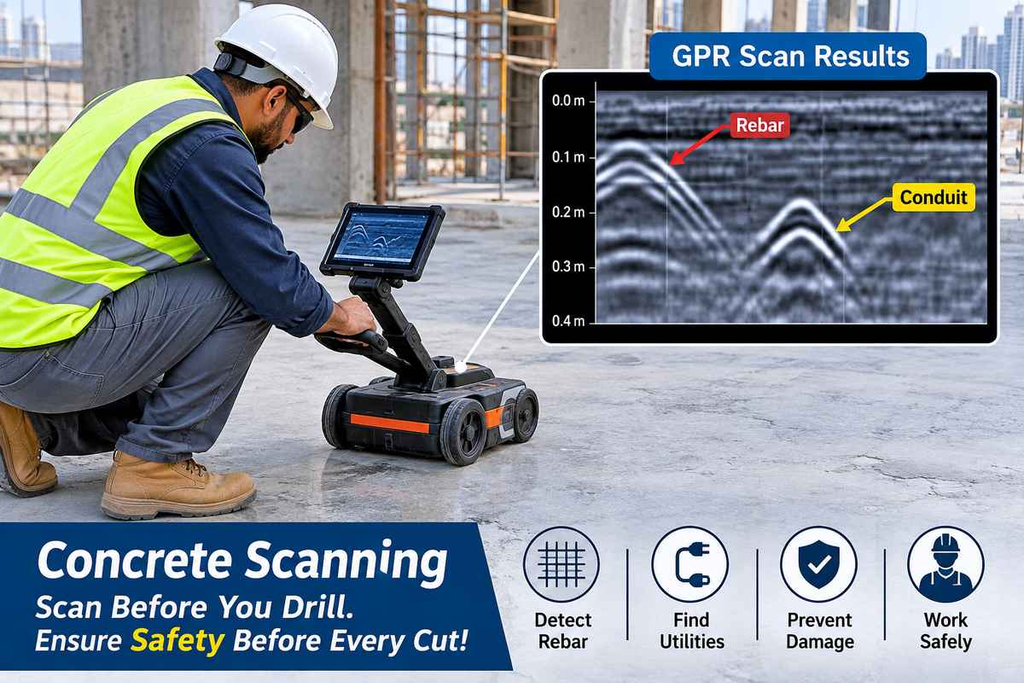
A concrete slab looks solid from the outside. Inside it, reinforcement bars, electrical conduits and sometimes post-tension cables run in every direction. One careless drill hole can cut a live conduit, weaken the structure or injure the operator. Concrete scanning removes the guesswork. This article explains how it works, what it finds, when you need it and what limits its results.
What Is Concrete Scanning?
Concrete scanning is a non-destructive survey that detects objects hidden inside concrete. A technician moves a scanner across the surface and records what lies beneath it. The team then marks the findings on the concrete, so the next trade knows where it can safely drill, core or cut.
How Ground Penetrating Radar Works in Concrete
Most concrete scanning uses ground penetrating radar, or GPR. The scanner sends short radar pulses into the concrete. When a pulse meets a material with different properties, such as steel or a void, part of the signal bounces back.
The instrument records the return time and builds an image. A buried bar appears as a curved arc on the screen, and the technician reads its position and depth from that arc. Higher-frequency antennas give sharper detail but reach less deeply. Lower frequencies reach deeper but show less detail. A skilled operator picks the frequency that fits the slab.
What Concrete Scanning Can Detect
- Reinforcement bars and mesh, including spacing and approximate cover
- Electrical and communication conduits, including live ones
- Post-tension cables, which carry very high loads
- Embedded pipes and sleeves
- Voids, honeycombing and changes in slab thickness
A rebar cover meter, which uses electromagnetic detection, can also measure cover over bars. GPR goes further, because it can also pick up non-metal objects such as plastic conduit and shows depth in a single scan. Plastic gives a weaker signal, though, so the technician reads those results with extra care.
When Concrete Scanning Is Required
Scan before any work that penetrates concrete. Typical cases include core drilling for pipes and ducts, cutting new openings, fixing anchors and bolts, and demolition. Structural assessments use scanning too, for example to check bar spacing in an older building.
Check the existing drawings first. A set of structural drawings shows where designers planned the reinforcement. Drawings can be wrong or out of date, however, so scan anyway. Teams that plan early also include scanning in the pre-construction survey scope, which avoids delays once work begins.
Limitations That Affect Scan Results
GPR is powerful, but it has limits that every client should understand.
- Dense reinforcement: Closely spaced bars can hide objects beneath them.
- Moisture and salts: Wet concrete or concrete with a high salt content weakens the signal. Coastal conditions in the UAE can make this a real factor.
- Fresh concrete: Concrete that has not cured holds a lot of water, which limits the scan. Allow time for it to dry.
- Depth: Detail fades with depth, so very thick elements may need a different method.
- Access: The scanner needs a clean, reasonably flat surface.
A good technician explains these limits before scanning and flags any area where the result is uncertain. Treat an unclear reading as unknown, not as clear.
The Scanning Process, Marking and Reporting
The work follows a simple sequence. First, the team reviews the drawings and agrees the areas and the purpose. Second, it sets a grid on the surface and scans along it. Third, the technician interprets the data on site and marks bars, conduits and cables directly on the concrete with paint or chalk.
Reporting then records the findings. A typical report includes marked-up plans, photographs and notes on any uncertain areas. The office team can turn these into drawings through a CAD service. If the structure also sits near buried services, a utility survey completes the picture.
Safety and Regulatory Considerations in Abu Dhabi
Scanning does not replace safe working practice. Treat every marked conduit as live until the electrician proves otherwise. Never cut or drill through a post-tension cable without the structural engineer’s approval, because a released cable can cause serious injury. Keep the scan marks visible until the work finishes, and re-scan if the work moves to a new area.
Projects in Abu Dhabi also follow health and safety rules. The Abu Dhabi Public Health Centre publishes the occupational safety framework, and the Department of Municipalities and Transport sets requirements for building works. Confirm which permits and approvals apply before you start.
Conclusion
Concrete scanning gives you an accurate picture of what sits inside a slab or wall before you cut it. Scan first, mark the results clearly, respect the limits of the method and involve the structural engineer for anything critical. That routine protects people, services and the structure at a very small share of project effort.
Frequently Asked Questions
What is concrete scanning?
It is a non-destructive survey that locates rebar, conduits and cables inside concrete before drilling, cutting or coring.
Does concrete scanning damage the concrete?
No. The scanner moves across the surface and does not touch the structure.
Can GPR detect post-tension cables?
Yes, in most cases. Always confirm their position with the structural engineer before any cutting.
Is concrete scanning the same as a utility survey?
No. Concrete scanning looks inside slabs and walls, while a utility survey maps buried services in the ground.
How thick a slab can GPR scan?
The depth depends on the antenna frequency, the moisture and the reinforcement. Ask the technician to confirm the limit for your slab.
Pingback: GPR Concrete Scanning: How Technicians Plan and Read a Scan